HP 49G
The HP 49G is a graphing calculator that Hewlett-Packard announced in May 1999. It keeps the HP 48's RPL and the same 4 MHz Saturn processor, but adds a computer algebra system, algebraic entry beside RPN, and a ROM in flash memory that owners can update themselves.
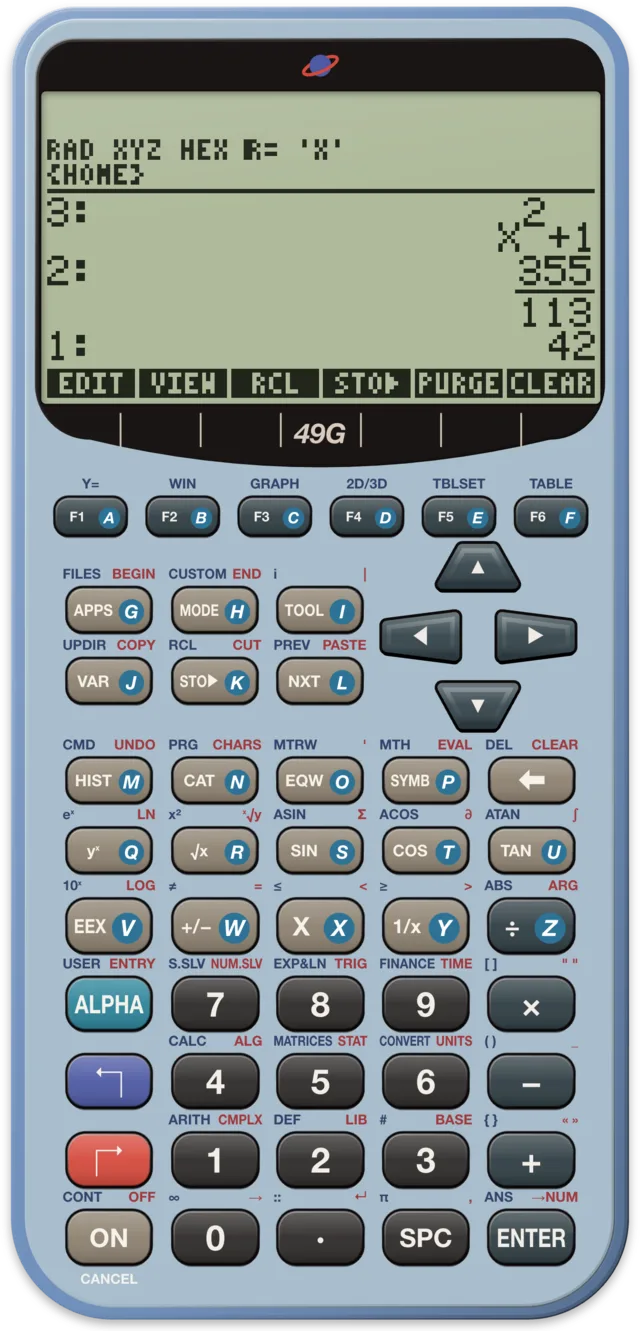
At a glance
| Announced | 21 May 1999, at the OpenHP conference in Paris |
| On sale | August 1999, at $180 |
| Discontinued | 2003 |
| Processor | Saturn core in HP's Yorke chip, 4 MHz |
| Memory | 512 KB RAM, 2 MB flash (1 MB for the ROM, 1 MB for you) |
| Display | 131 × 64 pixels, black instead of the 48's blue |
| Keyboard | 51 rubber keys, with a blue and a red shift key and a green alpha key |
| Entry | Algebraic or RPN |
| Input and output | 10-pin serial port, beeper; no infrared, no card slots |
| Power | Three AAA cells |
| Size and weight | 183 × 87 × 23 mm without its cover, 264 g |
| ROM versions | 1.05 at launch, 1.18 the last official one; later 1.19-6 and 2.10 |
History
A new system on the old processor
After the HP 48GX, HP hired some of the best-known HP 48 programmers to build its next calculator. The HP 49G FAQ names Jean-Yves Avenard, Gerald Squelard and Cyrille de Brebisson of the Meta Kernel team; Mika Heiskanen, the author of ALG48 and Jazz; and Bernard Parisse, the author of Erable. The team rewrote the operating system mainly in assembly language. Input forms, choose boxes and the file manager became 10 to 100 times faster.
The processor stayed the same. A new one would have meant rewriting the system from scratch, and the FAQ notes that the HP 48 alone had taken over 200 engineer-years. A faster Saturn was not easy either. Dave Arnett, who designed the 48G series hardware, explained that at the edges of the manufacturing process and at extreme temperatures the Yorke chip is already marginal at 4 MHz. HP had even considered sorting the chips and selling the 48G as a 2 MHz machine.
The launch
HP announced the 49G on 21 May 1999 at the OpenHP conference in Paris, and in the US on 21 June at the conference of the American Society for Engineering Education. It went on sale in August at $180. HP's virtual museum says its 1.75 MB of memory was three times that of any other calculator on sale at the time.
The 49G looked different from the 48. Its case is a metallic ice blue with a translucent slide-on cover; the FAQ says HP chose the colour to appeal to younger buyers. Its keys are rubber, but they still have a tactile feel. ENTER is a small key in the bottom right, as on other makers' graphing calculators. And it starts in algebraic mode: most buying decisions are made in a shop within three minutes, the FAQ explains, and most people do not know RPN. Three keys switch it to RPN for good.
What it left out
The 49G has no infrared port. The FAQ gives two reasons. Teachers in many countries feared the HP 48's infrared would be used to cheat, and schools in much of Europe, Australia and Africa had banned it. And the Saturn chip has a single high-power output, which the 48 used for its infrared and the 49G needs to write its flash memory. A cable between two 49Gs comes in the box, with an adapter for a 48.
The card slots went too, and with them the Equation Library. The library of physical constants stayed, as did the units, now 127 of them, and ROM 1.14-3 added the multiple equation solver.
ROM updates
Since the ROM sits in flash memory, HP could fix bugs after the calculator shipped. The first 49Gs had ROM 1.05. The last official release, 1.18, came on 27 May 2000; a beta, 1.19-6, followed in October 2001. A 64 KB boot sector cannot be erased, so a 49G whose flash is wiped can load a new system from a PC without going back to HP.
What came after
In 2000 the same CAS went into the HP 40G, a school calculator built on the 49G's design. In 2003 the source code of Parisse's part of the CAS was released under the LGPL. In August 2003 HP released the 49g+, with an ARM processor that runs the Saturn code through emulation, and in October the 48gII. Versions 2.09 and 2.10 of the later ROM were back-ported to the original 49G.
What makes it special
Computer algebra
Bernard Parisse is the main author of the CAS. It grew out of his Erable library and Mika Heiskanen's ALG48, both programs for the HP 48. It works with exact numbers and symbols, factors and expands, solves equations and differential equations, takes limits, derivatives and integrals, and handles symbolic matrices. For calculus and linear algebra it can show each step.
Some results, as saturnus's command reference ran them:
'X^2-1' FACTOR             gives (X-1)*(X+1)
'X*EXP(X)' INTVX           gives (X-1)*EXP(X)
'X^2-4=0' SOLVEVX          gives {X=-2,X=2}
It is fast for a 4 MHz machine. The FAQ times 100!*100! with full precision at about 1.5 seconds; a 48 with ALG48 needs 16.
Algebraic or RPN
The 49G works either way: type 1+2 and press ENTER, or put 1 and 2 on the stack and press +. Results can show in textbook form, as in the picture, or on one line. Most commands appear in menus you choose from with the arrow keys; set flag -117 and they go back to the 48's menu keys. The CAT key lists every command, with those of installed libraries.
Flash memory
Of the 2 MB of flash memory, 1 MB holds the ROM and the rest is port 2, where you keep programs and libraries. A memory clear does not touch it. HP rated the flash for a million erase cycles.
Programming
The 49G runs User RPL as on the 48, and HP 48 programs move over as text. Built into the ROM are also tools that HP did not support: from ROM 1.14-2 a System RPL compiler and an assembler, and from 1.14-3 a decompiler too. HP 48 programs stored in binary form do not run, since the ROM's entry points moved: they have to be compiled again from their source.
The serial port
The 10-pin connector, shaped like the HP 38G's, carries a serial port and the signals for HP's overhead projector display. It speaks Kermit, as on the 48, and XModem with 1 KB blocks and a CRC; the 49G can also act as an XModem server. On the PC, HP's Connectivity Kit for the 48 and the 49G came with HPComm, a Windows program by the author of saturnus and Mitch Davis of HP.
In saturnus
saturnus runs the 49G with ROM 2.15, from the ROM package hpcalc.org offers for emulators; ROM 2.10 runs too:
- Its screens were checked against those of the saturnng emulator, and satx's Kermit tests pass on it.
- Programs take as long as on the real calculator, within a few percent. For long ones, switch to 2×, 4× or Max.
- The memory view shows variables, directories, the stack and the flags, read live from the calculator's RAM. Variables open in an RPL editor, and a program pasted into the app is typed into the command line key by key.
- Files moves variables between your computer and the emulated 49G, or a real 49G on a serial cable (in Chrome or Edge on a computer), by Kermit or by the faster XModem.
- The flash memory is emulated, so a saved 49G state holds all of it, the ROM included.
The command reference lists the 49G's 830 commands with their stack effects, and examples for 659 of them, run in saturnus.
Sources
- HP 49G FAQ, maintained by Eric Rechlin: the hardware, the flash and its boot sector, the size and weight, why there is no infrared and no card slot, the colour, the keyboard, algebraic mode as the default, the team, the speed and Dave Arnett on the processor, the CAS, the Equation Library and units, the programming tools, the ROM versions.
- HP 48 FAQ 4.62, edited by André Schoorl, section 2.14: the announcement in Paris and the 49G's features as Jean-Yves Avenard listed them.
- Finseth's HP calculator data: HP 49G: the OpenHP and ASEE announcements, the Yorke chip, the keyboard's shift keys, ROM 1.05 in the first calculators.
- HP Virtual Museum: HP 49G: the price, the memory against other calculators, step-by-step solving.
- Wikipedia: HP 49/50 series: the release in August 1999 and the end in 2003, the ROM releases, the LGPL source, the 49g+ and the 48gII.
- Wikipedia: HP 39/40 series: the 40G of 2000 with the 49G's CAS.
- Bernard Parisse: Xcas and the HP 49G and 40G: his part in the CAS of the 49G and the 40G, ALG48 code inside it, the LGPL licence.
- HPComm, the archive on GitHub: HPComm 3.0 in HP's Connectivity Kit.