HP 48SX
The HP 48SX is a graphing calculator that Hewlett-Packard introduced in March 1990. It put the RPL system of the HP 28S into a case with two card slots, a serial port and two-way infrared. Owners used that serial port to share programs online, and many did.
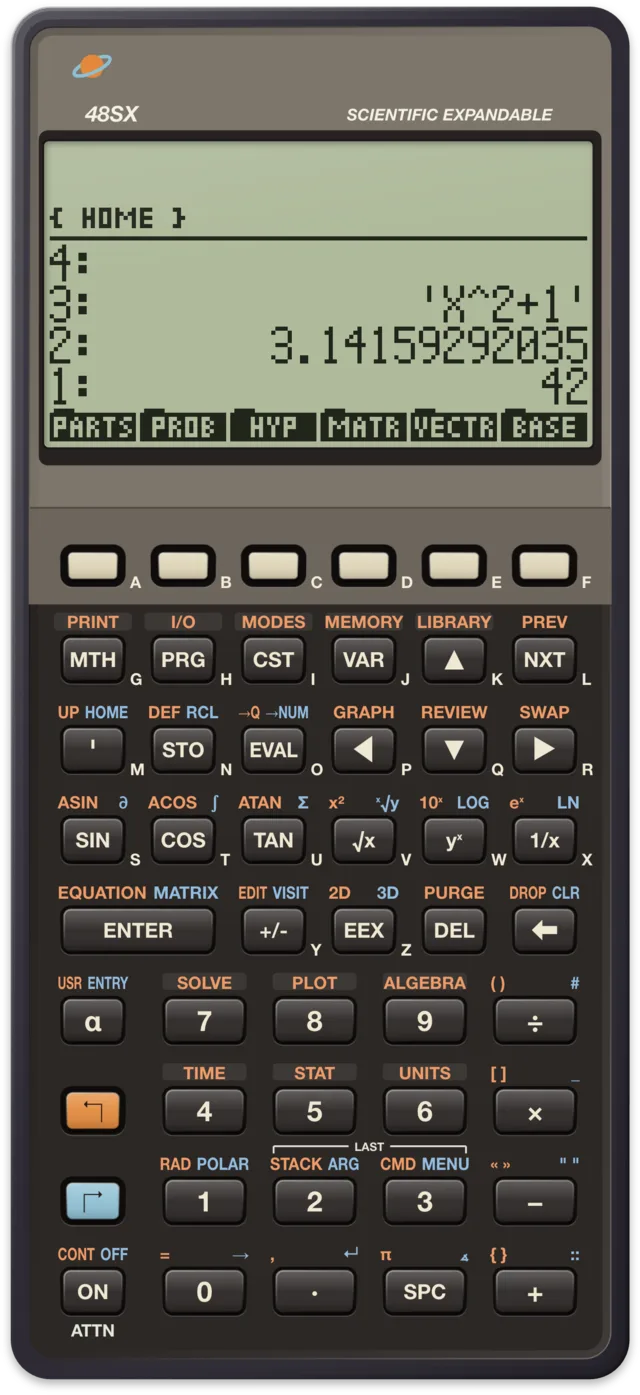
At a glance
| Introduced | 6 March 1990, at $350 |
| Code name | Charlemagne |
| Processor | Saturn core in HP's Clarke chip, 2 MHz |
| Memory | 32 KB RAM (up to 288 KB with two cards), 256 KB ROM |
| Card slots | Two, up to 128 KB each |
| Display | 131 × 64 pixels, 8 lines of 22 characters |
| Keyboard | 49 keys, with an orange and a blue shift key |
| Input and output | Serial port (1200 to 9600 baud), two-way infrared, beeper |
| Power | Three AAA cells |
| Size and weight | 180 × 81 × 25 mm, 264 g |
| ROM revisions | A to E, then J |
History
The HP 41C and the HP 28S in one
By the late 1980s HP had two top calculators that suited different people. The HP 41C had plug-in ports, a keyboard you could redefine and HP-IL for printers and drives; engineering departments and surveyors used it. The HP 28S had RPL, symbolic maths and a graphics display, and many colleges adopted it for mathematics. But it had no ports and almost no input or output, so engineers were slow to take it up.
The 48SX project began with a review of what was good in each. Its developers, Bill Wickes and Charlie Patton, wrote in the Hewlett-Packard Journal of June 1991 that the goal was "a product that combines the software technology of the HP 28S with the hardware flexibility and customizability of the HP 41C". The model number says the same: 48 joins the 41 and the 28.
HP 28S owners had asked for a bigger display, more plotting, a way to load and save programs, symbolic integration and more help with the harder features. All of these went in. The integration request grew into a larger idea: the EquationWriter, where you draw an expression as it looks on paper.
What could not be kept
One thing could not please both groups. To have its other features, the 48SX had to use RPL, so HP 41C programs could not run on it. HP sold a plug-in card that emulated the HP 41C and ran its programs; a 41C with its infrared printer module could even send programs to the 48SX through the infrared port. Most HP 28S commands ran unchanged.
Building it
The 48SX was not designed from a clean sheet. HP's engineers reused as much as they could from its one- and two-line calculators, such as the HP 17B, 32S and 42S, and built the 48SX on the same production line at the same time. The HP Journal calls this coproduction. Finseth's data sheet records one setback: a capacitor used in manufacturing warped some cases and stopped the line for a week.
The 48S, the ROM revisions and the 48G series
In 1991 HP added the HP 48S at $250: the same calculator without the card slots. The Museum of HP Calculators gives their production runs as 1990 to 1993 for the 48SX and 1991 to 1993 for the 48S.
The ROM went through revisions A to E. They share a bug in the EquationWriter that can garble an expression when parentheses are switched on and off; in spring 1991 HP ran a trade-in program that gave owners revision E. Revision J, from about December 1992, fixed the bug, made the EquationWriter about twice as fast and sped up graphics scrolling. It also moved some undocumented ROM entry points, so a few older programs stopped working. The letters F to I were skipped or never reached the public in numbers.
In 1993 the HP 48GX and 48G followed, with input forms, the Equation Library built in and a processor twice as fast. HP offered 48S and 48SX owners a trade-in. The 48SX stayed in production for a while, since much of its software did not run on the G series. The 48GX's code name, ALCUIN, follows from this one: Alcuin was Charlemagne's teacher.
What makes it special
RPL and the stack
The 48SX works on a stack of objects: real and complex numbers, strings, lists, arrays, programs, algebraic expressions, graphics and more, eighteen types for the user. RPL programs have loops, local variables and user-defined functions, and the whole keyboard can be redefined. Finseth's data sheet counts among the 48SX's firsts the interactive stack, opened with the up arrow, where you move, copy and delete entries; and the MatrixWriter, a spreadsheet-like editor for arrays.
Units everywhere
Numbers can carry units through any calculation, the solver and plots included. The 48SX has 121 units built in, and you can build any compound unit from them. The HP Journal's example asks how fast an object moves after accelerating at 1 m/s² for half a minute from 20 mph:
'1_m/s^2*.5_min+20_mph' EVAL gives about 87.1_mphThe calculator converts the minutes and metres itself and checks that the dimensions fit.
Cards
The two slots take RAM cards of 32 or 128 KB, with their own battery, so a card keeps its contents when you take it out. They also take application cards. HP's Solve Equation Library card holds 315 equations in 15 subjects, with pictures of the problems, a periodic table, physical constants, a solver for several equations at once and a finance application. On the 48GX most of it is built in. The game Minehunt came on the same card.
The Museum lists many more cards from HP and other makers: mathematics, statistics, business, mechanical and electrical engineering, circuit analysis, surveying, navigation and games.
Serial port and Kermit
HP chose a serial port instead of HP-IL, since personal computers already had one. HP used Kermit for transfers, because it corrects errors by sending again, was widely used, and was free for all the common personal computers. The same Kermit runs over the serial port and the infrared, so there is one way to learn.
The serial port arrived as the internet was spreading through universities. Owners shared programs in the comp.sys.hp48 newsgroup and later on many web sites. The Museum lists some of what they wrote: remote controls, terminal emulators, satellite tracking, Star Trek tricorders using the infrared, and even a C compiler for the calculator.
Two-way infrared
The 48SX was the first HP calculator whose infrared port could receive as well as send. It prints to HP's infrared printer and exchanges objects with another 48SX. The receiver works only up to two or three inches (5 to 8 cm). The HP Journal says it was kept simple and cheap, and that it is switched off with the calculator so that bright light does not drain the batteries. The Museum of HP Calculators says HP also limited the range at the request of teachers who worried about messages passed invisibly in class.
In saturnus
saturnus runs the 48SX with ROM revision J, the last one:
- Its screens were checked against those of the saturnng emulator, and satx's Kermit tests pass on it.
- Programs take as long as on the real calculator, within a few percent: a timed benchmark loop matches a real 48SX's time. For long programs, switch to 2×, 4× or Max.
- The memory view shows variables, directories, the stack and the flags, read live from the calculator's RAM. Variables open in an RPL editor, and a program pasted into the app is typed into the command line key by key.
- Files moves variables between your computer and the emulated 48SX, or a real HP 48 on a serial cable (in Chrome or Edge on a computer). The 48SX speaks Kermit only, so the fast XModem transfer of the 48GX and 49G is not offered.
- The command-line saturnus also takes RAM card files for both slots, up to 128 KB each.
- The infrared port is not emulated.
Some results differ from a 48GX because the 48SX ROM computes them differently. One is HMS+: 0.5959 0.0001 HMS+ gives .6 instead of 1. A real 48SX gives the same, so it is the ROM, and the command reference notes it.
The command reference lists the 48SX's 397 commands with their stack effects, and examples for 329 of them, run in saturnus.
Sources
- Hewlett-Packard Journal, June 1991: "The HP 48SX Scientific Expandable Calculator: Innovation and Evolution" by William C. Wickes and Charles M. Patton (the design goals, the HP 41C emulator card, the 121 units and the mph example, the 18 object types, the 49 keys, the eight plot types, the cards); Eric L. Vogel on the Equation Library card; Preston D. Brown on the custom chip and its UART; Steven L. Harper and Robert S. Worsley on the input and output system, Kermit and the infrared range; Richard W. Riper on coproduction.
- Museum of HP Calculators: HP-48S/SX: the 41C and 28C lineage, the interactive stack and MatrixWriter, the serial port, the cards on sale, the internet culture and its programs, why the infrared range is short, the 48S, prices and production runs.
- Finseth's HP calculator data: HP 48SX: the date and price, the code name, the Clarke chip, memory, display, keys, size, weight and power, the ROM revisions and the trade-in, the warped cases, the firsts, production after the 48GX's launch.
- HP 48 FAQ 4.62, edited by André Schoorl: the differences from the G series, the 288 KB maximum, the ROM revisions and their bugs, revision J, the trade-in for the G series, the code names Charlemagne and ALCUIN, Minehunt on the Equation Library card.