HP 17B
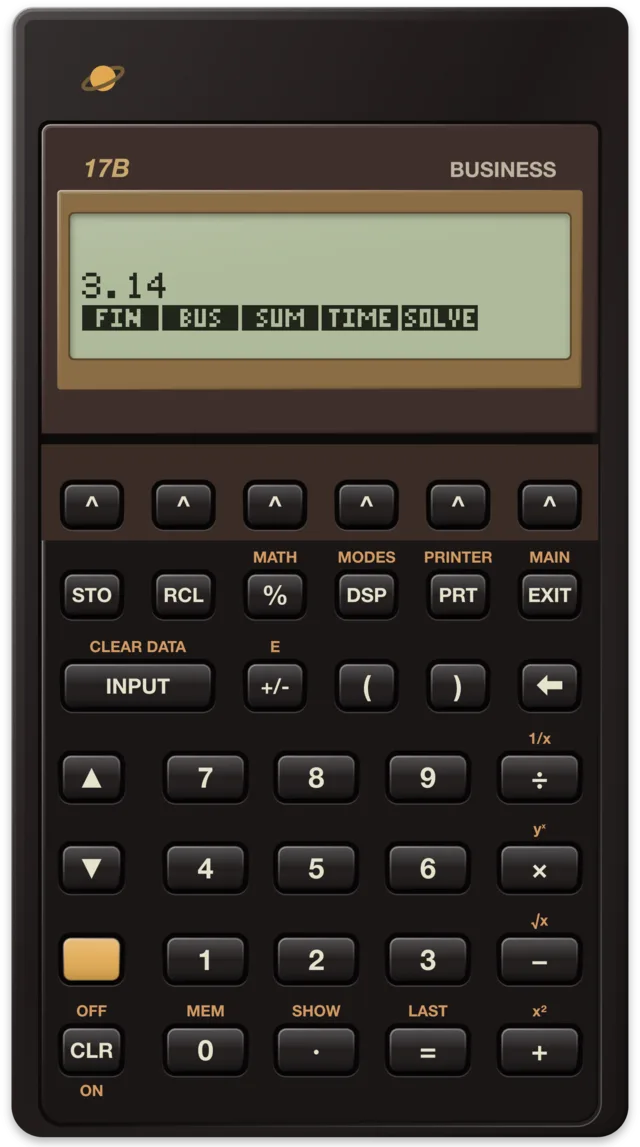
The HP 17B is a business and financial calculator that Hewlett-Packard sold from January 1988 to January 1990. It works through menus on a two-line display: money over time, cash flows, bonds, depreciation, percentages, statistics and a clock. For anything not built in, you type your own equation into its solver. In 1990 the HP 17BII replaced it and added RPN.
At a glance
| Released | 4 January 1988, at $110 |
| Discontinued | January 1990 |
| Code name | Trader |
| Processor | Saturn core in HP's Lewis chip, about 1 MHz |
| Memory | 8 KB RAM (6.5 KB for you), 64 KB ROM |
| Display | Two lines of 22 characters, 131 × 16 pixels |
| Keyboard | 37 keys, one shift key, six menu keys |
| Entry | Algebraic, in chain order (no precedence) |
| Input and output | Infrared output to HP's 82240A printer, beeper |
| Clock | Time, date and appointments |
| Power | Three button cells |
| Size | 147 × 78 × 15 mm |
History
From the Business Consultant
The 17B's way of working comes from the HP 18C Business Consultant of 1986. The Hewlett-Packard Journal of August 1987 describes how HP designed it: the HP-12C sold well, so its features met customers' needs, but HP held focus panels on both coasts of North America to find out how to make them easier to use. Many people disliked keyboards cluttered with labels. HP's answer was menus on the display above six blank keys, and Solve, a way to enter your own equation and solve it for any variable. The 18C was HP's first menu-driven calculator.
The 18C got its extra keys from a second keyboard, in a case that opens like a book. In January 1988 HP brought its ideas to two new business calculators: the 19B, named Business Consultant II, in the same kind of case, and the 17B in a slim pocket case.
Launched with three others
On 4 January 1988 HP introduced four calculators at once: the 17B, the 19B, the 27S and the 28S. An electronics magazine reported in March 1988 that all four have HP Solve and print by infrared to HP's 82240A printer.
The 17B and the 27S were the first of HP's Pioneer series, slim calculators built around Lewis, a custom chip with an improved Saturn processor core. Wikipedia notes that the two share the same hardware. The 42S followed in October.
The manual's first edition is dated August 1987, five months before the launch.
One language or six
The 17B came in two versions. The one sold in the United States speaks English only. The international one, according to Wikipedia, offers six languages: English, German, Spanish, French, Italian and Portuguese. The manual's troubleshooting section answers the question of a confused owner: if the messages are not in English, the MODES menu has an INTL menu to choose the language.
Replaced by the 17BII
In January 1990 the 17BII took the 17B's place at the same price. It added RPN as a choice beside algebraic entry; the rest stayed close to the 17B.
What makes it special
Menus and prompts
The Museum of HP Calculators describes the 17B's keyboard as unusually sparse: a single shift key, with shifted functions on only about 40% of the keys. Most of its functions are in menus. The bottom line of the display always shows one, usually the main menu with FIN, BUS, SUM, TIME and SOLVE.
Menus that calculate share one pattern. Key in a number and press a variable's menu key to store it; press the key alone to calculate that variable. A loan, for example, has the number of payments, the interest rate, the present value, the payment and the future value: enter any four, press the fifth.
Chain order
The 17B calculates in the order you type, without precedence. The manual's example: type 456 − 75 ÷ 18.5 × 68 ÷ 1.9 and the display shows each intermediate result, 381.00 after the division sign, then 20.59 after the multiplication, and so on, to 737.07. Parentheses group where you need them. Pending operations stay on the display.
Behind the line you type on, the calculator keeps a short history of results, and the LAST key brings the previous one back into your calculation.
The applications
- Time value of money for loans, savings, leasing and amortization.
- Interest conversions between nominal and effective rates.
- Cash flows: net present value and internal rate of return.
- Bonds: price or yield on any date.
- Depreciation: straight line, declining balance, sum of the years' digits and ACRS.
- Business percentages: percent change, percent of total, markup.
- Statistics: mean, correlation, linear estimates.
- The clock: time, date and appointments that beep when due.
The solver
The manual puts it plainly: for problems that are not built in, type an equation and solve for any unknown. "It's easier than programming!" The solver makes a menu of the equation's variables, which work like the built-in ones.
In saturnus
saturnus runs the international 17B, main ROM revision B with its language ROM:
- On a first start it asks for the language. It boots, computes, and the ROM checks of its self-test pass. Its ROM is 96 KB: the 64 KB main ROM and a 32 KB language ROM.
- "Set the clock" sets the 17B's clock to your computer's time, by pressing the keys of its TIME menu as you would; not while it asks for the language. Appointment alarms have not been tested.
- On your computer's keyboard, F1 to F6 press the menu keys and Escape is CLR.
- The CPU runs at 1 MHz, the figure the sources give for its chip. No timing of a real 17B has been measured to check it against, so run times are an estimate. 2×, 4× and Max speed it up.
- Save and load states work as on every model.
What it does not do: the 17B has no serial port, so Files has nothing for it, and the infrared printer output is not emulated. The memory view and the RPL editor are for the HP 48 and 49 only.
The command reference lists the 17B's 254 functions with the keys that run them, and examples for 56 of them, run in saturnus.
Sources
- HP 17B Owner's Manual: the applications, the solver and "easier than programming", 6.5 KB of memory, the 82240A printer, the chain calculation example, the language question, the edition date.
- Finseth's HP calculator data: HP 17B: dates and price, code name, entry logic, the first Pioneer, display, processor, power, RAM and ROM.
- Finseth's HP calculator data: HP 18C: the 18C's year.
- Hewlett-Packard Journal, August 1987: Susan L. Wechsler, "A Handheld Business Consultant": the HP-12C's influence, the focus panels, uncluttered keyboards, softkey menus, Solve, HP's first menu-driven calculator.
- Museum of HP Calculators: HP-17B: the sparse keyboard, the menus, chain order with pending operations, the history and LAST, the features, years.
- Wikipedia: HP-17B: the launch date with three others, the six languages, size, the 17BII in January 1990.
- Wikipedia: HP-27S: the 17B and 27S share their hardware; the keyboard of the Pioneer series.
- Wikipedia: HP-28 series: Lewis as a custom chip with an improved Saturn core.
- Electronics & Technology Today, March 1988: the four calculators launched together, HP Solve and infrared printing.